
Let nothing disturb there,
Nothing affright there;
All things are passing;
God never changeth;
Patient endurance
Attaineth to all thing;
Who God possesseth
In nothing is wanting;
Alone God sufficeth.
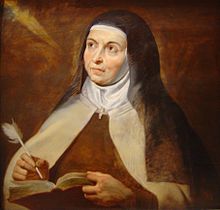
St. Teresa of Avila
P.P. Reubens
Teresa of Avila 1515-1582 was a prominent Spanish mystic, Roman Catholic saint, Carmelite nun, writer, theologian and Doctor of the Church. Her works include her autobiography, The Life of Teresa of Jesus, The Interior Castle and The Way of Perfection. The kernel of Teresa’s mystical thought throughout all her writings is the ascent of the soul in four stages. She is one of the foremost writers on mental prayer and her place among writers on mystical theology is unique. In writing on this subject she deals with her personal experiences, which a deep insight and analytical gifts enabled her to explain clearly. St. Teresa was observed multiple times levitating during mass.
* *
God is pure no-thing,
Concealed in now and here:
The less you reach for him,
The more he will appear.
Angelus Silesius 1624 – 1677 was a German Catholic priest and physician know as a mystic and religious poet whose works included more than 200 hymn texts used by Catholic and Protestants, and more than 1,600 alexandrine couplets. His poetry explores themes of mysticism, quietism and pantheism. Argentine writer and poet Jorge Luis Borges frequently references Silesius and said the essence of poetry could be encapsulated in Silesius’ line, “The Rose is without ‘why’- she blooms because she blooms.”
Here are two prominent mystics presenting two faces of the mystic encounter. St. Teresa declares that God is everything, He never changes and fulfills every need of the soul. Angelus Silesius, on the other hand, presents a very Buddha-like statement – “God is pure no-thing” – not, as some interpret this position as Nothingness or Emptiness. The Unmanifest is pure potential before it takes form which of course, means it contains everything as St. Teresa states. It is interesting to note that Silesius also says God is found in the here and now – not on a cloud in some distant heaven.
This autobiographical information was culled from Wikipedia and the original articles are quite interesting, especially Silesius who influenced many future writers and philosophers.
 Remembering the Sacred Self
What a marvelous paring!
LikeLike